By Bobby Cupparo — Color Realism Specialist, Austin TX + NYC | 13+ years, thousands of pieces
Color realism tattoos cost more than most other styles — typically 20–30% above a comparable black and grey piece, and often significantly more than that at the specialist level. The reasons are technical, not arbitrary. A color realism session involves managing hue, chroma, saturation, color temperature, and value structure simultaneously, in real time, on living skin, with no ability to erase. That's a different category of work than most tattooing. The pricing reflects that difference.
I'm not going to put a single dollar figure in this article. The moment a number lands on a page, it becomes an anchor — something to argue toward before you've told me anything about what you actually want. What I can do is explain, in honest terms, exactly why the investment is what it is. Once you understand what's actually happening during a session, the question stops being "why does it cost this much?" and starts being "how is any of this even possible?"
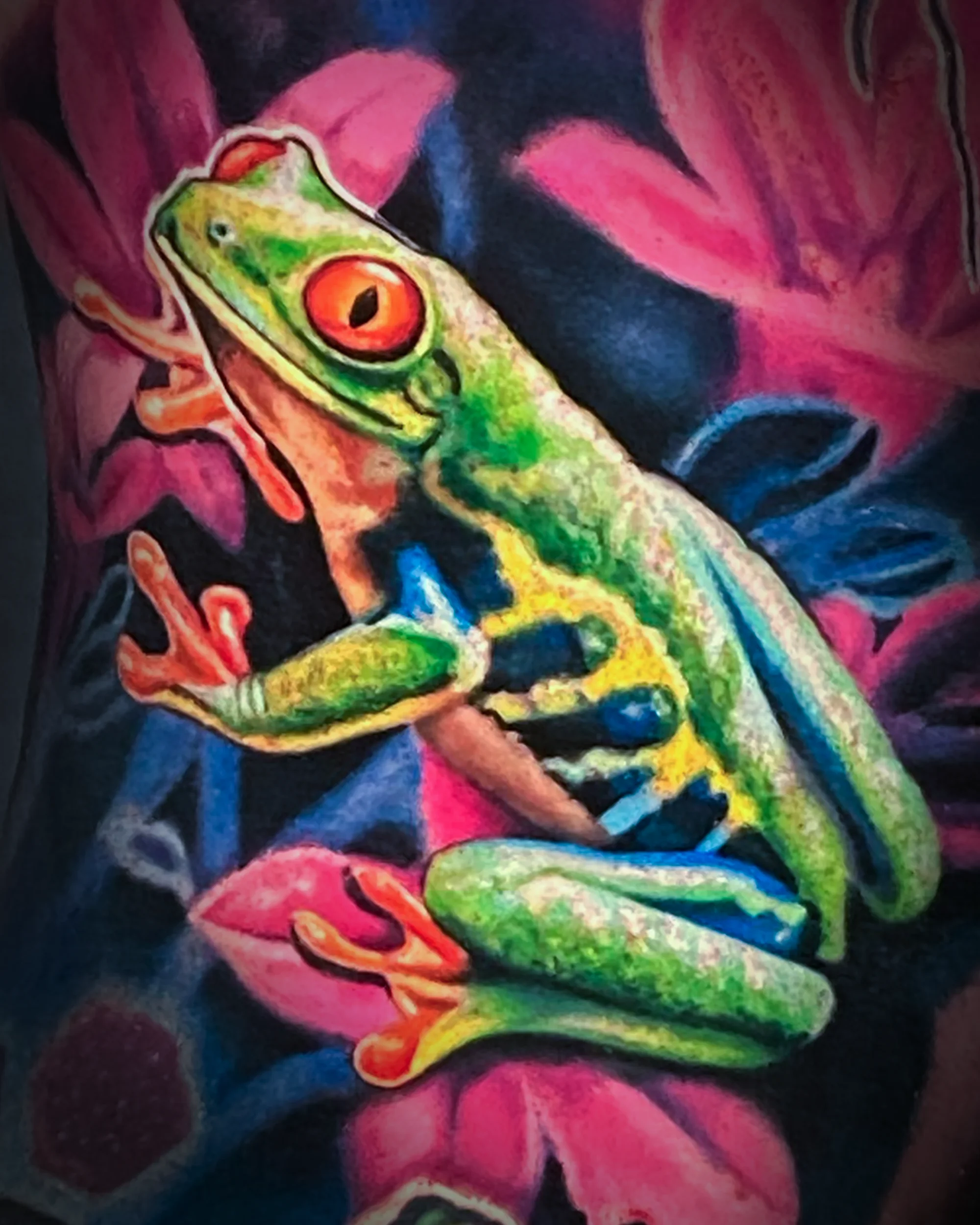
How much does a color realism tattoo cost compared to other tattoo styles?
Color realism costs 20–30% more than comparable black and grey work at minimum — often more at the specialist level — due to session length, material cost, and cognitive complexity.
Here's the simplest version of the comparison:
| Style | Relative Cost | Key Variables |
|---|---|---|
| Black and grey realism | Baseline | Single pigment, value only |
| Traditional / neo-trad | Baseline–10% above | Bold lines, limited palette |
| Color realism | 20–30%+ above baseline | Full color mixing, multi-session likely |
| Color realism (full sleeve) | Significantly above | Multiple sessions, extensive planning |
These are directional, not exact. Your specific piece — subject, size, placement, color complexity — determines the real number. But the structure holds.
Why is color realism more expensive than black and grey tattooing?
Color realism requires managing five simultaneous variables — hue, chroma, saturation, color temperature, and value — where black and grey only requires one: value.
Black and grey is one pigment, watered down to varying concentrations. You're solving a two-dimensional problem the entire session — light and dark, always within a single pigment family. That's real skill, and I have deep respect for the work. But the cognitive load is categorically different.
Color realism is managing a full oil-painting's worth of decisions in real time. Every shadow carries a color temperature component. Every highlight is a judgment call about warm or cool. Every transition is a live question: are you moving the hue, the value, or both? The number of variables in play at any given moment in a color realism session is an order of magnitude higher.
And it's all permanent. A painter working toward the same level of realism can sit on a decision, step back, paint over it, correct it the next day. I'm making those same decisions in skin — decisive, irreversible, on a surface that's reacting to every pass. That's the actual skill being paid for. It's slower by nature, not by choice.
What is the "needle rinse problem" and how does it add to tattoo session time?
Every color change in a color realism session requires thorough needle rinsing to prevent pigment contamination — this happens dozens of times per hour and compounds significantly across a long session.
Most clients never think about this part. Every time I change colors — which in a color realism piece happens constantly — I have to rinse the needles thoroughly before moving to the next color. Dirty needles muddy the work. They drag unwanted pigment into a new zone. They destroy transitions that took time to build.
So I rinse. Then I rinse again. Sometimes after rinsing and dipping into the next color, I realize the tone is going slightly wrong — too warm, off in chroma — and I set it down and recalibrate. Sometimes I go into two or three ink caps to land on the exact color relationship I'm after, test it in an inconspicuous area of the piece, and start over if it's not right. This is precision, not inefficiency. But precision takes time, and time is what you're ultimately paying for.
There's also the surface management — with strong, saturated colors, the paper towel absorbs so much pigment that wiping the work area can smear color across the piece instead of cleaning it. You're swapping paper towels constantly, keeping the area clean enough to actually see what you're doing. These aren't dramatic moments. They're micro-interruptions, dozens of times per hour, across the full length of a session. They add up.
What are the actual material costs for a color realism tattoo?
Color realism requires 15–20+ distinct ink colors per complex piece, plus specialty pigments, larger ink caps, and significantly more ink per session than black and grey work — all at higher material cost.
A black and grey artist operates with one primary pigment. Maybe a handful of supporting inks — a few greys, a white for highlights. The palette is fundamentally simple. One quality bottle of black ink covers a tremendous amount of work.
For color realism, I buy significantly more ink — dozens of bottles across the color spectrum, plus specialty pigments for specific hues and effects. A single complex piece might draw on fifteen, twenty, or more distinct colors, plus blends of those colors mixed on the fly. I also use larger ink caps because I need room to fully dip without the needle grouping hitting the bottom of the cap — which means I go through considerably more ink per session than what actually ends up in the skin.
Color ink is richer and thicker than watered-down black. That viscosity is part of what makes it vibrant and durable when healed correctly — but it also means saturation takes longer. Thicker pigment moves through the skin differently. You can't rush it. Push too aggressively and you damage the skin. Go too soft and you risk inadequate saturation. You're teetering that line for the entire session.
Here's something most people don't know: you can overwork the skin by underworking it. Too many light passes that don't commit to the right depth traumatize the skin more than fewer deliberate passes done correctly. The goal is confident, layered saturation — letting the skin accept what it's receiving before coming back for depth. That takes skill and time. Both factor into the cost.
How many sessions does a color realism tattoo take?
Most significant color realism pieces require 2+ sessions. This is intentional — second-session work over healed skin produces better depth and saturation than a single marathon session.
There are three reasons for the multi-session approach, and none of them are shortcuts.
Skin absorption limits. Skin can only take so much detail and ink saturation in one sitting before it starts to fight back. Overworked skin swells, becomes less receptive, and begins rejecting pigment rather than holding it. Pushing past that threshold doesn't produce more progress — it produces trauma that degrades the final result. I read the skin throughout the session and stop at the right point, not at an arbitrary time limit.
Client threshold. Color realism sessions are long and technically demanding. The work doesn't have the natural rhythm of outline-then-fill that traditional tattooing does — it's continuous, highly detailed coverage that concentrates sensation in ways some placements intensify considerably. Not every client can hold position and stillness for the full duration a complex piece needs in one sitting. That's not a character flaw. It's physiology, and it has to be planned for honestly.
Second sessions produce better work. This is the part people don't expect. When I come back to a fully healed piece, I'm layering new color over settled, stabilized pigment. The depth achievable in that second pass — building on what's already in the skin — is qualitatively different from a single push. The layering between healed sessions is part of what gives color realism its characteristic three-dimensional quality. I'm mixing on the skin over time the same way I mix in ink caps during the session. Both contribute to the final result.
If you're preparing for a first session, the Tattoo Prep Guide covers everything you need to know — what to eat, how to sleep, what to wear, and how to manage healing between sessions. It's free.
Why do color realism artists book slowly — and why does that affect pricing?
Top color realism artists limit their weekly session count because the cognitive demand of managing full color work accumulates in ways that degrade quality. Limited capacity reflects the style's demands, not arbitrary scarcity.
I can't do six color realism sessions in a week and produce my best work on all six. Managing hue, chroma, temperature, and value simultaneously — across sessions that run long and require full concentration — accumulates in ways that don't reset overnight. Running too many sessions degrades the quality of each one.
There's also the physical side — executing detailed work in an awkward, often hunched or leaning position for hours at a time, on another person who may be shifting or flinching, so you're bracing them with one hand while working with the other. Every color realism artist I know deals with back and shoulder accumulation over years. You're paying for the skill, the time, and honestly — my future chiropractor appointments.
After extended color work, my concentration degrades in a way I've learned to recognize. I stop before it becomes a factor in quality. That's not a limitation I apologize for. It's responsible practice.
The limited weekly capacity is structural, not arbitrary. Artists at this level structure their weeks around quality output. Fewer sessions, each with the focus the work actually requires. That structural reality affects how calendars fill and how pricing works.
What makes a color realism piece more or less expensive?
The primary cost drivers are subject complexity, number of distinct color relationships, size, placement, and realistic session count — two pieces both labeled "color realism portraits" can have entirely different scopes.
Not all color realism is priced the same. A portrait with warm, even lighting involves fewer simultaneous color decisions than a portrait with colored side lighting on a complexly-toned subject. A piece with simple, clean color fields takes a different technical approach than one with dozens of color temperature shifts across a single surface.
Here's a concrete example. If I'm tattooing a portrait with blue side lighting on a subject with warm orange undertones, that light doesn't just sit on top of the orange — it interacts with it. Where it hits directly, I get a cooled, slightly desaturated zone. Where it wraps into shadow, the blue bleeds into the orange-toned area, creating a complex intermediate. Where the light falls away entirely, the shadow picks up ambient warmth. I have to map that interaction across every surface, every plane change, every anatomical shift — in ink, in skin, permanently. That is a different piece than a simple portrait with neutral lighting.
Placement matters too. Certain areas of the body — high-friction, high-movement zones — require additional saturation at application time to account for how they'll heal and wear. That affects session length.
The right conversation about your specific project happens at the planning stage, not from a price list. Visit the portfolio to see the range of what this work actually involves.
What do you actually get when you invest in color realism at this level?
Color realism done well produces work that doesn't look like a tattoo to people who see it — it reads as something closer to a painting that exists in skin. That's a different category of result.
I've watched it happen consistently: someone wearing a significant color realism piece in public, and a stranger stops — not to offer a polite compliment, but because they genuinely don't understand what they're looking at. The dimensional quality, the color relationships, the way it interacts with light. It doesn't register as tattoo at first. That reaction is consistent enough that I'd call it the defining characteristic of the style executed correctly.
Color realism has stayed relevant through every trend cycle the industry has moved through — and its hybrid with surrealism continues to push what's possible. It's not a style that spiked and faded. Artists at the technical edge are still pushing what's possible, still raising the standard. The reason it endures is simple: when it's done correctly, the results justify the investment completely.
Every decision is intentional — the color relationships, the saturation approach, the layering sequence. Nothing in this work happens by accident, and nothing costs what it does without a reason you can point to technically. See the portfolio to understand what that looks like in practice.
For more on how I approach sessions, see the process page. If you're comparing approaches, the post on color realism vs. surrealism clarifies where each excels. For the longevity question, how color realism ages addresses that directly.
Frequently Asked Questions
These are the questions that come up most. For broader questions about the work, visit the full FAQ.
Why is color realism more expensive than other tattoo styles?
Color realism is categorically different work from most tattooing. It requires managing hue, chroma, saturation, color temperature, and value structure simultaneously — on the fly, for the entire session, in a permanent medium with no ability to correct mistakes by painting over them. Black and grey work involves one pigment, value contrast only. Color realism involves all of that plus full color mixing in real time. Longer sessions, higher material costs (15–20+ distinct inks per complex piece), limited artist capacity per week, and the cognitive intensity of the work all compound on each other. The result is a genuinely different investment structure — not arbitrary, and not negotiable with a "regular tattoo" budget as the baseline. See the color realism overview for more on the style.
How much does a full sleeve color realism tattoo cost?
A full color realism sleeve is a multi-session, multi-month project — the total investment reflects that scope. Because the work is done in sessions (typically 4–8+ depending on complexity and client tolerance), the full cost accumulates over the course of the project rather than landing in one payment. Each session is priced based on its duration and complexity. What you won't get from any honest color realism artist is a flat sleeve price quoted upfront, because the actual scope — the color relationships, the number of elements, the technical demands of the specific reference — determines that. The right way to approach a sleeve is through a planning consultation where the scope gets defined, then priced session by session. Start your project to begin that conversation.
What factors affect color realism tattoo pricing the most?
The primary drivers are: (1) subject complexity — how many distinct color relationships the piece involves; (2) size and realistic session count; (3) placement — high-friction or high-movement areas require additional work to saturate correctly; (4) color temperature complexity — simple color fields versus complex lighting interactions; (5) the artist's experience level and weekly capacity. Two pieces both labeled "color realism portraits" can have entirely different scopes and session counts depending on the reference material and what the subject requires technically. Visit the pricing page for more.
Is paying more for a color realism specialist worth it versus a general tattoo artist?
Color realism is one of the most technically demanding styles in tattooing — managing full color mixing in real time, on a permanent medium, without the ability to revise. An artist who specializes in it has spent years developing the specific skills the style requires. A general tattoo artist attempting color realism without that background produces a different quality of result — often visibly so after a few years, as under-saturated or poorly mixed color ages differently than work done correctly. The investment in a specialist is the investment in a result that holds and reads as intended five and ten years out. With 13+ years and thousands of color realism pieces, the body of healed work is the evidence.
How should I budget for a color realism tattoo?
Budget for the full scope of the project, not the first session. Most significant color realism pieces are multi-session — building the budget around session one and hoping the rest is cheaper is how people end up with unfinished work. Get a planning consultation, understand the realistic session count for what you want, and build the budget around that total. Also account for healing time between sessions — for complex pieces, you're typically looking at 8–12 weeks between sessions to let the skin fully settle before the next pass. The timeline is part of the investment. Start your project here.
Can I negotiate a lower price for color realism?
Not productively, no. The cost structure for color realism reflects real technical constraints — session length, material costs, limited weekly capacity — none of which change because of negotiation. What you can do is scope the project thoughtfully. A smaller, focused piece done with full technical commitment will outperform a larger piece rushed through at a lower price point. If the full scope of what you want is outside your current budget, a planning conversation can identify what's possible now versus what makes sense to add in a future session. The right approach is honest scoping, not negotiation.
How many sessions does a color realism tattoo take?
Most significant pieces require 2+ sessions — and that's intentional. Skin can only absorb so much detail and saturation in one sitting before it starts to fight back. A second session over fully healed work allows layering new color over settled, stabilized pigment. The depth achievable in that second pass is qualitatively different from a single push. The layering between healed sessions is part of what gives color realism its characteristic three-dimensional quality. Read more on the process page.
Ready to talk about your project?
You don't need to have every detail figured out before reaching out. Bring the idea — the reference, the general placement — and we'll work out the details from there.
I work out of Austin, TX and New York City.
Contact: INFO@BOBBYCUPPARO.COM
If you're moving toward booking a first session, start with the Tattoo Prep Guide — it covers everything that makes a session go well from your side.