These two styles get grouped together all the time — both use vivid color, both take serious technical skill, and from a distance, both can look like they belong in the same conversation. They don't.
Color realism and surrealism tattoos are built on different foundations, done with different intent, and serve different purposes for the person wearing them. I've spent 13 years doing both — thousands of pieces across the full range (see the healed gallery for examples) — and the question I get more than almost any other is: which one is right for me?
Short answer: Color realism renders a subject as accurately as possible. Surrealism uses that same technical skill to build something that could never exist in the real world. The right choice depends on what you're trying to say with the piece.
Here's the long answer.
What Is the Difference Between Color Realism and Surrealism Tattoos?
Color realism is a tattoo style that aims to replicate the subject with photographic accuracy — correct light sources, shadow mapping, color temperature, and naturalistic proportion. Surrealism is a tattoo style that combines realistic rendering with impossible or dreamlike composition — elements that couldn't coexist in reality, placed together with intentional visual logic.
The key difference isn't skill level. Both styles demand technical depth. The difference is in the purpose of the work.
In color realism, technique serves accuracy. In surrealism, technique serves atmosphere.
How Is Color Realism Applied Differently Than Surrealism?
Color realism is built through layered color washes over a tight foundation. The process is closer to oil painting than illustration — you establish form first, then build saturation in transparent passes, then push highlights and deepen shadows until the subject reads as dimensional. Every color decision is anchored to what the subject actually looks like in natural or directional light.
Surrealism uses the same layering mechanics — the saturation still has to be pushed deep enough to read well in skin, the shadows still need to wrap correctly — but the composition breaks from observable reality. Scale shifts. Elements merge that would never exist together. Backgrounds become environments that couldn't exist: cosmic fields, geometric planes, liquid color transitions.
The difference that matters most: in realism, I'm solving for accuracy. In surrealism, I'm solving for internal coherence. The piece has to make sense on its own terms, even if those terms are entirely invented.
Color Realism vs Surrealism Tattoos: Side-by-Side Comparison
| Dimension | Color Realism | Surrealism |
|---|---|---|
| Core Technique | Layered color washes over tight foundation; light/shadow accuracy | Same layering mechanics; composition breaks from observable reality |
| Color Approach | Saturated but naturalistic; accurate color temperature shifts | Pushed past naturalistic — neon, impossible palettes, atmospheric color |
| Composition Rules | Subject centered; backgrounds support without competing | No rules — scale shifts, merging elements, impossible environments |
| Typical Session Time | 4–8 hrs depending on subject complexity | 5–10 hrs; environmental complexity adds time |
| Ideal Subjects | Portraits, animals, botanicals, still life | Concepts, hybrid imagery, narrative scenes, environments |
| Aging Profile | Holds well when properly saturated; highlights fade first | Saturated fields age well; fine transition zones need most attention at touch-up |
| Client Fit | You want the subject to be recognizable; emotional directness | You want the piece to feel like something; narrative or atmosphere over documentation |
| Difficulty to Execute | High — accuracy is unforgiving | High — broken rules require deep rule knowledge |
What Is "Hyperbolic Surrealism" — and Why Does It Matter?
This is where I land most often, and where I think the real conversation is.
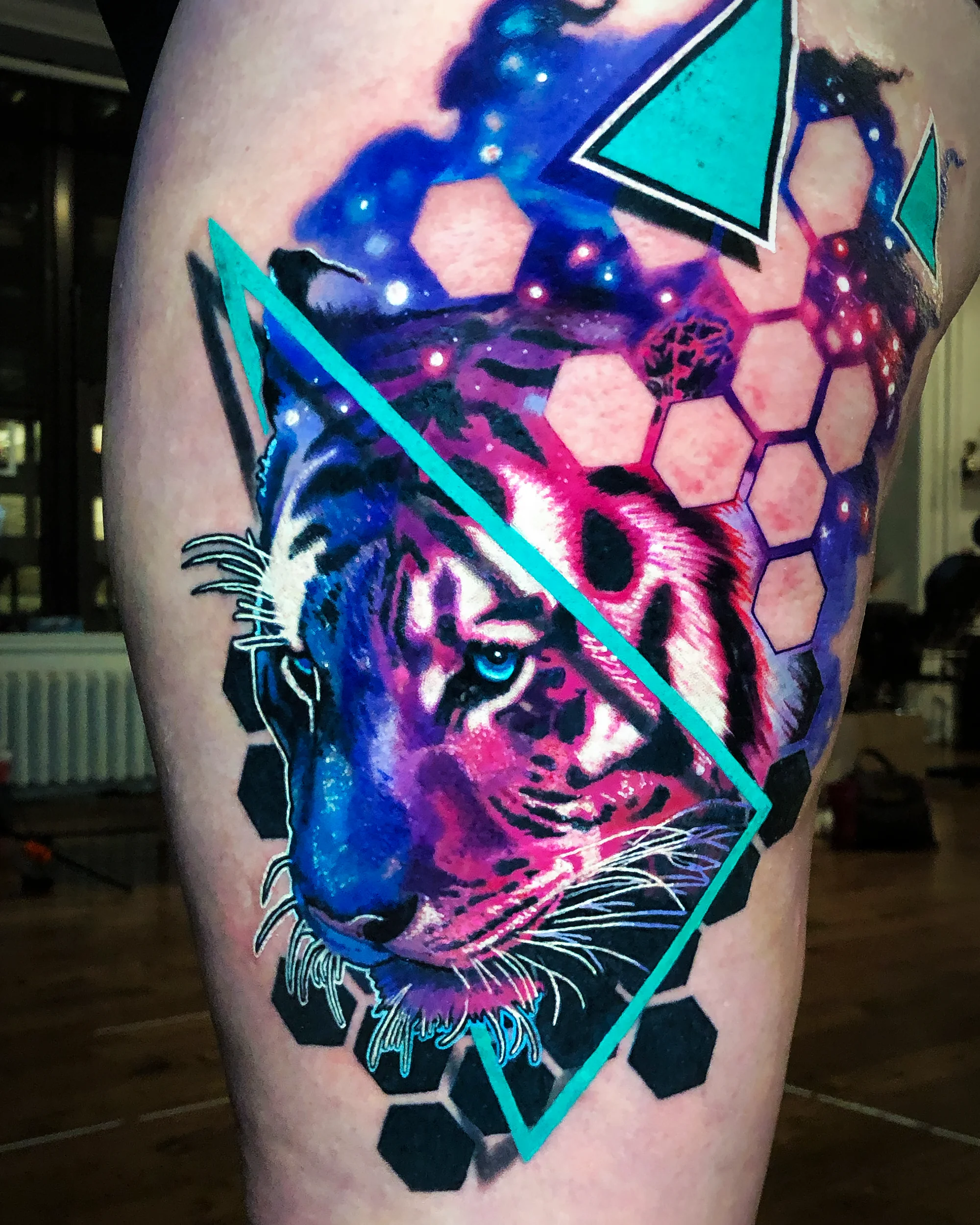
After years of doing pure realism and experimenting with full surrealism, I settled into something between them — what I call hyperbolic surrealism. It's realistic rendering applied to subjects that exist in completely impossible environments. A tiger rendered with photographic accuracy, placed in a field of geometric nebulae. A portrait with technically correct skin tones, where the background dissolves into something that has no name in the real world.
The realistic rendering makes the subject feel real. The impossible environment gives it a weight that pure documentation can't reach. The two elements do different work — one grounds the viewer, the other pulls them somewhere else.
I like to make it weird — something a little out there, something you don't see too often. That ethos shows up most directly in this hybrid approach.
The reason this works technically is that the rules aren't actually being broken. The light source in the subject is consistent. The color temperature holds. The rendering is sound. What's surreal is the context, not the execution. Every decision is intentional — even the ones that look like accidents.
How Does Color Realism Age Compared to Surrealism Tattoos?
Both styles age at a comparable rate when done right. The myth that surrealism ages better is mostly survivorship bias — you see the well-done pieces still looking sharp and forget how many under-saturated surreal pieces have muddied out.
Here's what actually determines aging across both styles:
Saturation depth. The decisions made during the tattoo determine the 10-year outcome more than almost anything else. Color that is pushed deep enough — multiple passes, proper layering — holds. Color that is applied too thin fades faster than most people expect. This is true for realism and surrealism equally.
The specific colors used. White and light pastels fade fastest in both styles. This matters more in realism — where a white highlight in an eye creates dimension — than in surrealism, where white is often used as an atmospheric element rather than a structural one. Properly saturated warm tones (reds, oranges, deeper yellows) hold better than most clients expect.
Placement. High-friction areas — hands, feet, inner elbows — age faster regardless of style. Sun-exposed areas fade faster. A surreal cosmic background on a forearm is going to need more maintenance than the same piece on ribs or thigh.
The fine transition zones. In surrealism, the areas where impossible elements merge into each other — where the wolf becomes the galaxy, where the geometric shape bleeds into skin — those transition zones require the most attention at touch-up. They're often the thinnest color, and thinly applied color is what fades.
Touch-ups matter for both styles. A check-in at 6–12 months, then every 3–5 years, keeps color realism and surrealism looking current. This isn't a flaw — it's maintenance, same way you maintain anything that matters. For a deeper look at longevity, see Do Color Realism Tattoos Age Well? 13 Years of Honest Observations.
How Do I Decide Between a Realism or Surrealism Tattoo?
The right style comes down to what you're trying to communicate — not what looks impressive.
Start here: is there a specific subject you need to look recognizable? A portrait — of a person, an animal, a place — where the likeness matters? That's a realism conversation. The power of realism is immediate recognition. You see it and you know what it is. No interpretation needed.
If what you're after is a feeling more than a subject — an atmosphere, a concept, a narrative that couldn't exist in reality — surrealism is the way to go. You want the piece to feel like something, not document something.
And if your idea lives somewhere in between — a realistic subject placed in an impossible environment, or a concept that needs to feel grounded and otherworldly at the same time — that's where I spend most of my time.
You don't need to have it all figured out. Bring the idea and let the conversation do the work — the FAQ covers common questions that come up at this stage. The right approach usually reveals itself once I understand what the piece needs to do for you.
Before you book, it's worth reading the Tattoo Prep Guide first. It covers what to bring to the conversation, how to reference images effectively, what information actually helps the design process — and what doesn't. Read the Prep Guide
How Long Does a Surrealism Tattoo Take vs a Realism Tattoo?
Both styles are time-intensive. Neither is a fast session.
Color realism session time depends primarily on the complexity and size of the subject. A detailed animal portrait on a 5×7 inch area typically runs 5–7 hours. A portrait with environmental background elements adds 2–4 hours depending on treatment. Smaller realism pieces — a tight botanical study, an isolated subject — can land in the 3–5 hour range.
Surrealism adds time through the environment. The subject itself may take comparable time to a realism piece. What adds hours is the background — a cosmic field, a geometric construct, a liquid color transition. These elements need their own compositional work, their own color logic, and their own rendering passes. A surreal piece with a detailed subject and a full environmental background often runs 7–10+ hours.
Hyperbolic surrealism — the blend — tends to land in that upper range. You're doing a fully rendered realistic subject and building an impossible environment behind it. The time reflects both.
Neither style can be rushed. The layering process that makes these styles work requires time per pass, and skipping passes is what produces color that fades in two years instead of lasting ten. Session length directly affects pricing — understanding why helps set realistic expectations. See also: How Much Does a Color Realism Tattoo Cost?
Frequently Asked Questions
What is the difference between a realism tattoo and a surrealism tattoo?
Color realism refers to tattooing that renders a subject — portrait, animal, botanical — with photographic accuracy: correct light, shadow, and color temperature. Surrealism uses the same underlying technique but composes elements that couldn't exist together in reality — impossible environments, scale shifts, non-naturalistic color palettes. Realism serves documentation; surrealism serves atmosphere. The technical demands of both are comparable, but the intent is different. An artist who does both well understands that surrealism isn't a departure from realism — it's realism applied to an invented world.
Can a tattoo be both realistic and surreal?
Yes — and this is increasingly where the most interesting color work is being done. The hybrid approach uses photorealistic rendering for the subject itself while placing that subject in an impossible or dreamlike environment. Bobby Cupparo refers to his version of this as hyperbolic surrealism: technically accurate subjects — rendered with correct light sources, layered color, dimensional shadow — set against cosmic backgrounds, geometric fields, or color atmospheres that have no equivalent in the observable world. The realism grounds it; the surreal environment gives it emotional range that pure documentation can't reach.
Do surrealism tattoos age better than realism tattoos?
Not inherently. Both styles age at comparable rates when properly executed. The primary aging factors — saturation depth at application, placement on the body, specific ink colors used — apply equally to both. Surrealism's reputation for aging well sometimes comes from survivorship bias: well-saturated pieces stand out years later, while faded ones disappear from the conversation. The fine transition zones in surrealism (where impossible elements merge) are often the thinnest color and need the most attention at touch-up. With proper saturation, smart placement, and maintenance touch-ups every 3–5 years, both styles hold.
How long does a color surrealism tattoo take?
A surrealism piece with a detailed subject and full environmental background typically runs 7–10 hours or more. The subject itself adds comparable time to a realism piece of similar scale — roughly 5–7 hours for a complex portrait or animal study. The environmental elements (cosmic backgrounds, geometric constructs, atmospheric color transitions) add additional hours depending on complexity. Neither style is a fast session; the layering process that produces lasting saturation requires time. Rushing either style produces color that fades faster than it should.
How do I know if I should get a realism or surrealism tattoo?
The decision comes down to what you need the piece to do. If you have a specific subject — a person, animal, or object — where the likeness needs to be immediately recognizable, realism is the right container. If you're after a feeling, a concept, or a narrative that requires elements that couldn't exist together in reality, surrealism serves that better. If your idea is somewhere between those — a real subject in an impossible environment, or a concept that needs to feel both grounded and otherworldly — the hybrid approach is worth exploring. Bringing reference imagery to a consultation, even loose or incomplete reference, helps clarify the direction.
Is color realism or surrealism harder to tattoo?
Both styles require advanced technical skill, and neither is more forgiving than the other — just unforgiving in different ways. Realism is unforgiving in accuracy: every proportion error, every color temperature mistake, reads immediately because the viewer has a built-in reference (what the subject actually looks like). Surrealism is unforgiving in internal logic: the impossible elements still have to feel inevitable. A surreal piece without coherent color harmony or compositional structure just looks confused rather than intentional. The artists who execute both styles well have typically spent years building the foundational craft before either style becomes achievable. It takes 13 years of doing this — and thousands of pieces — to understand where the real technical challenges live in each.
The Honest Summary
Color realism and surrealism aren't competing styles — they're different tools for different goals.
Realism gives you a subject that lives and breathes on your skin, rendered with enough fidelity that it communicates directly. No explanation required. Surrealism gives you an environment that couldn't exist anywhere else — something you carry that operates by its own visual logic.
The blend, when it's working, gives you both. The subject feels tangible. The world around it is impossible enough to feel like yours alone.
After 13 years and thousands of pieces working in both styles — and in the space between — I can tell you the right choice is always the one that's built for the piece, not the one that sounds impressive. There's no gradient. Either the approach serves the work, or it doesn't.
If you're thinking about a piece in either style, reach out.
I work out of Austin, TX and New York City, and take on a limited number of projects at a time — by design.
Email: INFO@BOBBYCUPPARO.COM
Locations: Austin TX | NYC
If you're not ready to book but want to understand the process first, start with the Prep Guide. It'll answer most of your questions before we ever talk.
Bobby Cupparo is a color realism and surrealism tattoo artist based in Austin, TX with an active NYC schedule. Thousands of pieces over 13+ years, specializing in color realism, surrealism, and the hybrid approach he calls hyperbolic surrealism.