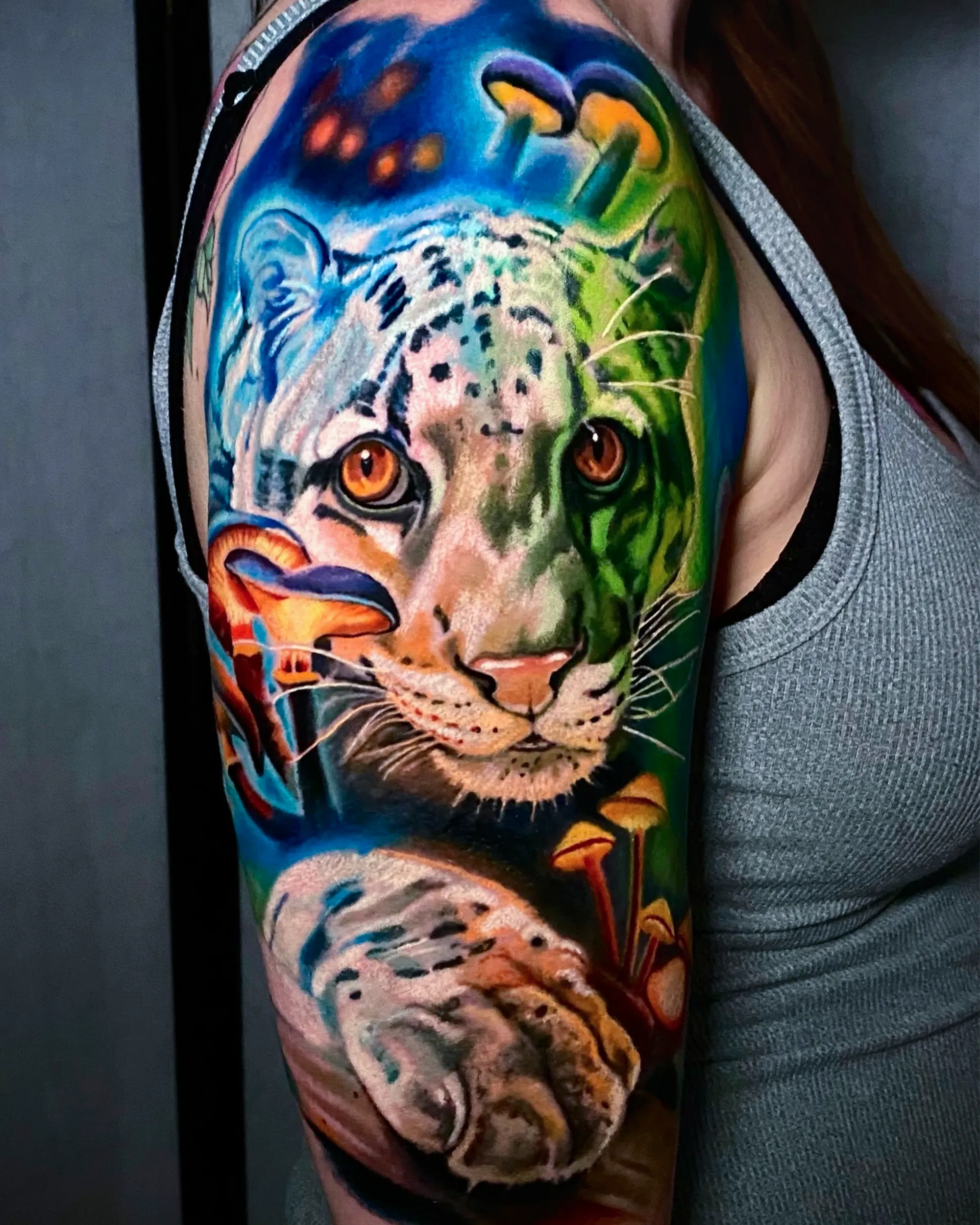
Yes. Color realism tattoos age well — not "well enough to settle for," but genuinely well. I've spent 13 years doing this work, watching pieces heal, and checking in on pieces that are 5, 8, even 12 years old on skin. The "color tattoos don't last" narrative is a myth. It's a specific myth with a traceable origin, and it's kept enough people from getting work they actually wanted that I think it's worth taking apart carefully.
What follows is what I've observed directly — from thousands of pieces, from watching other top artists' work age over time, and from understanding why color realism is built to last.
Not advice. Just honesty.
Where Did the "Color Tattoos Fade Fast" Myth Come From?
The fading myth originated in the late 1990s and early 2000s, when color realism was new, materials were limited, and established artists had reason to dismiss a style they couldn't execute.
Color realism emerged at the exact moment tattooing was transitioning from subculture to fine art. That shift created friction. Artists who built careers on traditional flash and bold outlines weren't equipped for what color realism demands — a completely different set of technical skills, materials knowledge, and patience. Some of them said so honestly. Others responded the way skilled people sometimes do when confronted with something they can't replicate: they dismissed it entirely.
The rhetoric that took hold — "looks great for a year, then turns into a blurry mess" — served a purpose. It was protective language. It spread through shops, through apprenticeships, through forums. It became the accepted truth before enough quality examples existed to challenge it.
There's a second layer. Early color realism wasn't yet perfected. Pigment formulations in that era had far fewer color options and significantly lower quality. Needles were cruder. The practitioners figuring out the style were doing it in real time, without the reference points that exist now. Some of those early pieces did age poorly — not because color realism is inherently unstable, but because the materials and techniques were still being developed. Those early results became the evidence used to indict the entire style. The indictment never got updated.
The third layer is simpler: there's a persistent assumption that tattoos should be quick and affordable. Color realism is neither. The idea that something this labor-intensive could also hold up for decades doesn't compute for people who equate tattoo quality with speed. When artist bias and cultural expectation combined, you got a myth with real staying power.
That staying power is why I'm writing this.
Do Color Realism Tattoos Age Well Compared to Other Styles?
Color realism ages as well as any style done today — and in some ways better than traditional work, because every square centimeter of the piece is fully saturated with ink.
People assume traditional tattoos age better because they're bold. There's some truth in that — bold outlines and solid black areas do resist migration well. But here's what gets left out: those thick black outlines spread. Ink diffuses through the dermis over decades. Look at a traditional tattoo from 40 years ago. The shape is there — but the bold lines have expanded into soft borders, and the flat fills inside them have blurred at the edges. The piece still reads, because it was designed to survive that kind of spread. Think about an older man's war tattoo. The shapes are legible, but the fine detail is long gone, softened into the surrounding skin.
Color realism uses the same principles — defined edges on color blocks, black massing in the right shadow zones — but they operate at a finer scale, hidden inside the rendering. That's not a weakness. That's intentional.
The black in the shadow areas isn't just there for contrast. It anchors the piece against migration over time. The color blocks transition across hard edges between light and shadow — those transitions hold their shape the same way a traditional bold line does, just without announcing themselves. Every decision in color realism that looks like it's about aesthetics is also doing structural work for longevity. Think of it like an oil painting: the underpainting determines whether the surface survives. The base layers you never see are doing half the work.
Here's what people miss: color realism is packed solid throughout. Every square centimeter — lights, midtones, darks — has ink in it. Compare that to black and grey work, which deliberately leaves areas of skin less saturated to create value and lightness. Those open areas are where black and grey "breathes." They're also where the skin tone takes over as a design element. As skin changes over decades, those open areas shift in ways the artist couldn't fully predict. Color realism doesn't have that variable. The ink is in there. All of it.
How Long Do Color Realism Tattoos Actually Last?
A well-executed color realism tattoo maintains its rendering, depth, and saturation for 10–15 years with basic care — and remains clearly legible for decades beyond that.
The determining factor isn't the style. It's three things: how the ink was put in, how the piece was healed, and how the skin was taken care of afterward.
Saturation decisions made during the tattoo determine the 10-year outcome. This is one of the things I think about constantly while I'm working — not just how a piece looks walking out of the shop, but how it's going to look when the client comes back five years from now. Under-saturated work looks thin at the start and fades to almost nothing over time. Properly saturated color, built in the right passes at the right depth, holds differently. The color is in there at a depth that doesn't disappear.
Touch-ups follow a predictable rhythm and are part of the overall investment structure. Most clients benefit from a check at 6–12 months after the initial piece to catch any areas that healed lighter than intended. After that, a touch-up every 3–5 years keeps color realism looking current rather than dated. That's not an indictment of the style — it's maintenance, the same way you maintain anything that matters.
When color realism ages poorly, it's almost always traceable to one of three things: overworked skin from a rushed session, aftercare that got treated as optional, or years of unprotected sun exposure. Those aren't style problems. They're execution and maintenance problems that would affect any tattoo, any style, any artist.
What Is the "Silver Skin" Phase and Is It Normal?
"Silver skin" is a temporary film that forms over a healing tattoo in the first 2–3 weeks. It is not fading — it's a normal part of the healing process and disappears as the skin settles.
This is one of the most common things I walk people through. Around days 7–14, a fresh tattoo can look washed out, almost milky — like the color you walked out with has already faded. It hasn't. What you're seeing is a thin layer of dead skin forming over the healing dermis. That layer is slightly opaque. It mutes the color temporarily.
The instinct is to panic. Don't. Once that layer sheds naturally — and "naturally" is doing a lot of work here, because picking or peeling it is how you actually damage the piece — the color comes back. Not all of it, always. Healing involves some loss, and some areas will need a touch-up. But the silver skin phase is not the loss. It's just the process.
I mention this here because it's directly relevant to the aging question: a lot of the "my color tattoo faded already" posts you'll find online are people misreading the silver skin phase as permanent fading. It's not. Give it four weeks before you assess anything.
Does Ink Color Affect How Long a Color Realism Tattoo Lasts?
Almost all pigments used in color realism hold well long-term. The one real exception is orange — certain premixed orange formulations have shown lower stability, which is why experienced artists mix their own.
I said I'd be honest about this, so here it is: orange has historically been the one weak point. Not every orange, and not in every brand — but certain premixed orange pigments from specific manufacturers have shown less stability over time than reds, yellows, blues, greens, and purples. This is well known in the industry. Any experienced color realism artist knows it.
The fix is straightforward: don't use those oranges. Mix your own. Yellow and red in the right proportions give you a more stable result, with precise control over warmth and saturation. This is the kind of knowledge that lives in the hands and the memory — not in tutorials. Every artist I've worked alongside at this level mixes their own orange. It's not controversial. It's just how you do it correctly.
Beyond orange, I've genuinely not seen aging problems with core color realism pigments when the work is applied well. Not with reds. Not with blues. Not with the deep greens that look almost impossible fresh and somehow hold even better healed. The issue was never color as a category — it was always substandard materials, inexperienced hands, and a narrative that refused to update when the evidence changed.
What Tattoo Placement Helps Color Realism Last Longer?
Placement affects color realism longevity mostly through sun exposure, not skin type or body movement. Areas with consistent UV exposure fade faster without consistent SPF use.
If there's one honest caveat about color realism aging, it's placement — but not for the reasons most people think. It's not about the skin in a given spot, or how much the area moves. It's about sun.
UV light breaks down ink. That's true of every tattoo, in every style, in every color. A black and grey piece on the forearm fades from sun exposure just as surely as a color piece. The difference is that color shows the early stages of fading more visibly — you notice a shift in saturation before you'd notice subtle graying in a black and grey piece. So color "looks like it fades faster" when what's actually happening is that the fading is more legible at earlier stages.
I think about this a lot with people who drive. The outer left forearm — the arm that rests on a car window — accumulates years of UV exposure just from commuting. People think about beach days. They don't think about the daily commute, repeated thousands of times. I bring this up with anyone planning work in that spot, regardless of style.
What I tell everyone, no matter the placement: SPF on tattooed skin is non-negotiable if you spend any time outdoors. Moisturize consistently. Don't let the skin get chronically dry. These aren't color realism instructions — they're skin instructions that happen to protect everything you've got. I use Hustle Butter Daily Rejuvenating Lotion for long-term maintenance on all my tattooed skin — see the full list of products I use.
How to Make Color Realism Tattoos Last Longer
The three things that determine color realism longevity are: proper saturation during the tattoo, correct healing in the first 6 weeks, and ongoing sun protection. All three are within your control.
Here's what it actually comes down to:
1. Start with an artist who saturates correctly. Under-saturation is the leading cause of premature fading — and it's invisible to you in the chair. The piece looks right fresh. The problem shows up two years later. Look at healed work, not just fresh work, when evaluating artists. Any artist worth their rate should have healed examples to show you — browse the healed gallery and the portfolio to see what that looks like.
2. Follow aftercare like it matters — because it does. The first six weeks determine whether the ink that went into your skin actually stays there the way it was placed. Keep it clean. Keep it moisturized. Stay out of the sun. Don't pick. Don't soak it in water. If any of this sounds obvious, that's because it is — and people still skip steps constantly.
3. SPF, consistently, forever. Not just in summer. Not just on beach days. If your tattoo is on a sun-exposed area, protect it. This is the single highest-leverage thing you can do for long-term color retention.
4. Come back for touch-ups on the right schedule. 6–12 months for an initial check. Every 3–5 years after that for maintenance. This isn't a sign of failure — it's the nature of permanent work in living skin. The artists who tell you their work never needs a touch-up are either working on people who never go outside, or they're not telling you the full story.
Before your appointment, there's more to think through — skin prep, diet, hydration, what to do the week before your session. I put it all in one place: Read the Tattoo Prep Guide before your session.
The Longer View
Color realism never went away. Through every trend cycle, every shift in the industry — every time some new style got declared the future — this one kept drawing serious clients, kept producing serious work, and kept holding up on skin. That's not accidental. Styles that deliver survive. Styles that don't, don't.
Thirteen years of doing this gives you a pretty clear picture. The people who invested in serious color realism work a decade ago aren't cautionary tales. Many of them have healed pieces that still read exactly as intended — the rendering is there, the depth is there, the color is there — because when this work is done correctly, it holds.
For more answers to common concerns, visit the FAQ. If the only thing stopping you from getting a color realism piece is "will it last" — let that go. The better questions are about design, placement, and finding the right artist for what you actually want. Take a look at the process, browse the portfolio, and see the results for yourself.
If you're ready to talk about a piece, reach out: INFO@BOBBYCUPPARO.COM. I work out of Austin, TX and New York City.
Frequently Asked Questions
Do color realism tattoos fade faster than black and grey tattoos?
No. Color realism is more thoroughly saturated than black and grey work, not less. Black and grey deliberately leaves areas of less-saturated skin to create lightness and value — those open areas are where skin tone becomes part of the design, and where aging skin introduces unpredictability over time. Color realism has ink in every part of the piece: lights, midtones, shadows. When it's applied at the right depth with proper saturation, it holds as well as any style being done today. The reputation for faster fading comes from poorly executed early work and a narrative that was never updated when the evidence changed.
How long does a color realism tattoo last before it needs a touch-up?
Most clients benefit from a check-in at 6–12 months after the initial session to address any areas that healed lighter than intended. After that, a touch-up every 3–5 years keeps the piece looking current. Color realism done at full saturation holds significantly longer between touch-ups than under-saturated work. Sun exposure is the biggest variable that shortens the interval — consistent SPF use on tattooed skin can extend the time between sessions meaningfully.
What is the "silver skin" phase in tattoo healing?
Silver skin refers to a thin, slightly opaque film of dead skin that forms over a healing tattoo during the first 2–3 weeks of healing. It temporarily mutes the color — sometimes dramatically — and is frequently misread as fading. It is not fading. Once the film sheds naturally (do not pick or peel it), the color returns. A full assessment of how a piece healed shouldn't happen before the 4-week mark. Most of the "my color tattoo faded immediately" posts on forums are describing the silver skin phase, not actual pigment loss.
Which colors hold up best in color realism tattoos?
Reds, blues, greens, purples, and yellows all hold well long-term when applied correctly. The one documented exception is orange — specifically, certain premixed orange pigments have shown lower stability over time. Experienced color realism artists mix their own orange from yellow and red rather than relying on premixed formulations. This gives more stability and precise control over warmth and saturation. Outside of that one exception, the "colors fade faster" concern applies only to work that was under-saturated at application — a technique problem, not a color problem.
Does placement affect how long a color realism tattoo lasts?
Yes, primarily because of sun exposure. Areas that receive consistent UV — the outer forearm, the back of the neck, the hands — fade faster without disciplined sun protection. The outer left forearm is a specific example I raise often: it accumulates significant UV exposure just from resting on a car window during a daily commute, something most people don't think about. Placement on areas with more friction (hands, fingers, feet) also introduces more wear over time. For most placements, committed SPF use is the single biggest lever for long-term color retention.
Does color realism age differently based on skin tone?
The core aging dynamics — ink depth, saturation, UV degradation — apply regardless of skin tone. What does vary is the visibility of certain colors against different skin tones, both fresh and healed. Lighter skin tones show full color range most clearly. On deeper skin tones, certain pigments — particularly lighter pastels and some yellows — read differently and may require adjusted saturation decisions at application to achieve the same visual result over time. This is one of the conversations I have during the design process. A competent color realism artist accounts for your specific skin when making saturation and color choices — it's not an afterthought. It's part of the plan from the start.
Can color realism tattoos look good at 10+ years old?
Yes. I've seen color realism work at 10–12 years that still has its rendering, depth, and saturation largely intact. The determining factors are all on the execution and maintenance side: was the ink applied at the right depth with proper saturation? Was the healing process followed correctly? Has the client protected the skin from UV exposure consistently? When all three answers are yes, a 10-year-old color piece can still look like the work was intended to — because the structural logic built in at application time does its job over decades. The work I've produced and watched my peers produce at the highest level supports this. It's not a claim. It's observation.
Bobby Cupparo is a color realism specialist based in Austin, TX with additional appointments available in New York City. 13+ years in the industry. Thousands of pieces. To talk about a piece or ask questions before booking: INFO@BOBBYCUPPARO.COM.