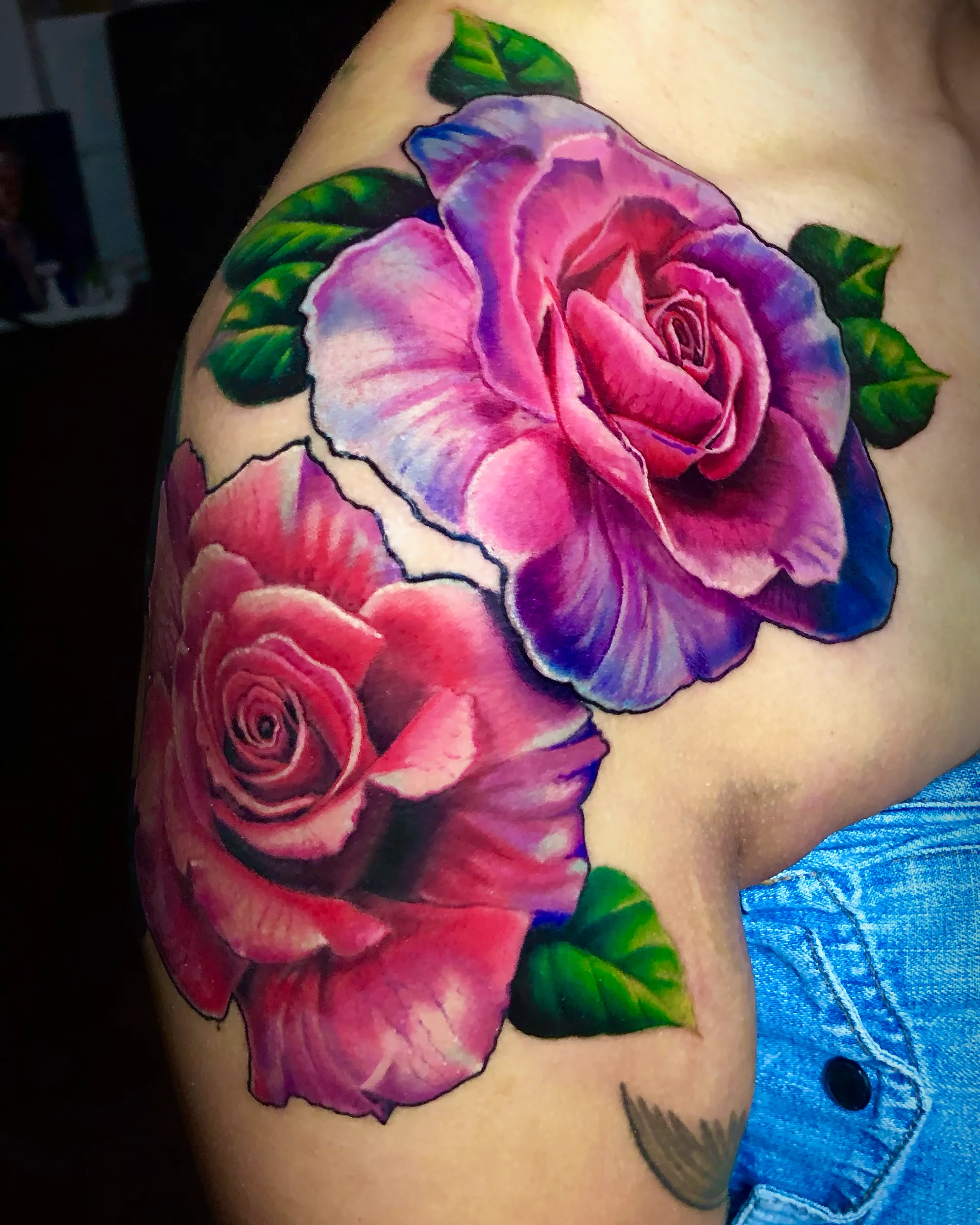
A tattoo is a wound going through a process. It's not an inconvenience — it's your skin doing real work, and it deserves to be treated that way. The healing process for color realism isn't dramatically different from other styles — but it is denser, and it helps to understand why. When executed well, the difference is often negligible. What matters is knowing what you're looking at so you don't panic at the wrong moment or intervene when the skin just needs time.
I've been doing this for 13 years. Thousands of pieces. I've watched a lot of tattoos heal. The ones that came back looking rough were rarely a technique problem — they were usually a client who got scared in week two and started doing too much. Or someone who forgot that they're healing a wound, not waiting out a sunburn.
Not advice. Just honesty.
Why Color Realism Heals the Way It Does
The core difference is pigment load — color realism leaves no area of skin unsaturated.
With black and grey work, the lightest areas of value are often open skin. The lightest tones are achieved by grazing, not packing. Color realism doesn't work that way. Whether I'm laying in the darkest shadow or building up to a bright white highlight, the method is the same — full saturation throughout. Every area of the piece has been worked. There's no relief zone.
Think of it like this: a color realism tattoo is built like thousands of tiny traditional tattoos sitting right next to one another — miniature blends and micro-saturations, each one precise on its own, that together compile what reads as a full photorealistic image. That technique is why the result looks the way it does. It's also why the skin has more to process.
More surface area worked means more secondary skin trauma — from the density of saturation, the level of detail, the number of passes, the wiping. It's not that healing is dramatically harder. It's that there's simply more going on, and the body responds to that accordingly. When done properly, the difference in healing is often negligible. But it's worth understanding the mechanics before you're staring at your arm wondering what happened.
If you want to understand how approach and execution affect longevity past healing, the post on whether color realism tattoos age well goes into that. The short version: healing and aging are connected.
The First Week: The Wound Phase
The first few days are the most straightforward — your body knows exactly what to do.
The tattoo is a wound. A well-executed one, but a wound. Your skin is responding the way skin responds: inflammation, sealing, beginning to rebuild. With color realism, you might notice more seepage than you'd expect from simpler work — that's just a function of how much skin was worked. Some of that fluid may carry color from surface-level pigment releasing. Normal.
Around days four through seven, the surface begins to tighten and flake. On color work, those flakes are tinted — you might see pieces of green, red, or blue lifting off the skin. This is where people start to worry. The tattoo looks like it's losing color.
It isn't. The flaking is just the outer layer of dead skin shedding — that's its job. The ink that defines your healed tattoo is already sitting where it belongs, deeper in the dermis. What's coming off is surface material. Let the flakes fall off on their own. Don't pick them — not as a fix, just as a precaution. Leave them alone and let your skin do what it knows how to do.
Week 2: The Hazy Phase
Around week two, the tattoo can look flat, muted, and possibly like something went wrong. It didn't.
This is the phase I make a point of explaining to every client before they leave the studio, because without context it's easy to spiral. The colors that looked sharp on day one look dull. The saturation seems gone. The piece looks off.
What's happening is the outermost layer of skin is still recovering. The ink is deposited below that layer — so what you're looking at is your tattoo showing through a surface that hasn't fully healed yet. Think of it like viewing a photograph through frosted glass. The image is all there. The frosted glass is just the outer skin still doing its work. Once that layer finishes healing, the clarity comes back.
A few things worth knowing about this phase: it's not unique to color realism. I've seen it across styles, and I've seen it more often on areas where the skin already has a denser or more callused texture. It's situational. It's usually fine. It resolves.
The counterintuitive part: the more saturated and detailed the work, the more apparent this phase can look — because you're watching a lot of variation, a lot of subtle detail, all softened at once. A heavier, denser piece will look more dramatically affected than a simpler one. That's not an indicator of a problem. That's the nature of what the piece is.
The wrong response is to over-moisturize in an attempt to fix it. More product doesn't clear the haze — it clogs the pores, doesn't allow the skin to breathe, and extends the very phase you're trying to move through. Too much ointment is not conducive to healing. Stay with your routine. Don't react to what you're seeing.
Weeks 3–6: Surface Healing Completes
By the end of week three, you'll start to see the piece coming back. By week six, you have the full picture.
The hazy quality starts to lift. Colors return. It won't happen uniformly across the whole piece — some areas will come back before others, and that unevenness is normal. Follow the trend, not the snapshot.
By weeks four through six, the surface is done healing. The tattoo reads the way it was designed to read. This is also the window where any genuine retention issues become visible and assessable — a spot that didn't hold, an area that looks patchy in a way that isn't clearing. That's when a touch-up conversation can actually mean something. Before six weeks, there's no useful information to act on. What you're looking at before then isn't the final piece.
The healed gallery shows what fully settled color realism actually looks like — documented after full settle, not fresh off the chair.
Months 2–3: The Deep Settle
Surface healed and fully healed are different things. The deeper settle takes time.
Realistically, the full healing timeline is four to six weeks for the surface. But the skin continues healing on a deeper level for up to two to three months. There can be a slight shine or gloss to the work even after the surface is healed — after a month or two, it sets into the skin and that resolves.
Colors can continue to subtly shift during this period. Contrast can sharpen. Things that looked slightly off at six weeks can smooth out on their own. Let it run its course.
If you want to understand how the piece was built and why the execution holds up over time, the process page covers that in detail. And if you're curious how color realism compares to other approaches before committing to a style, the post on color realism vs. surrealism is worth a read.
Aftercare: What Actually Matters
A well-executed tattoo should heal with no aftercare. But keeping it clean is non-negotiable.
I mean that. The skin is resilient. A properly done tattoo is built to last. But it's also a wound and a potential entrance for infection — like any wound — and keeping it clean is the one thing that isn't situational.
Everything else? It depends. The aftercare I give a client varies based on where the tattoo is — a high-movement area heals differently than somewhere more protected. It depends on their job, their lifestyle, whether the piece is finished or ongoing, whether they have prior experience and a preference that's worked for them. All of that factors in.
What I can say in general terms:
Keep it clean. Wash gently, keep the area free of anything that doesn't belong on an open wound, and treat it with some seriousness.
Don't over-moisturize. This is the most common mistake I see. People over-moisturize, picking at flakes is the second, sun exposure is the third. All of them come from the same place — an impulse to do something, to protect the investment, to feel like you're helping. Sometimes the most helpful thing is restraint.
Think about your overall health. This one gets overlooked. Your body is regenerating — it needs resources to do that. Rest. Time away from the gym if a heavy session is going to redirect healing resources elsewhere. Sleep. The overall condition you're in matters. Negligence is its own category of mistake — undervaluing that you have an open wound that deserves to be treated with some grace.
The prep guide covers both before and after in one place, and it's a good reference to have before your appointment.
Red Ink and Other Common Questions
The red ink reaction was a real thing — it's largely a historical footnote now.
Earlier on, when pigment companies hadn't fully dialed in their formulations — or in older days when artists made their own pigment — there was something called a "red reaction." An allergy. In 13 years, I've seen it once, early in my career. I've never had it occur with Radiant Ink, the brand I use exclusively. If you're working with a professional using quality, established pigment, this is not something to carry anxiety about.
If you have questions about materials or anything else before booking, the FAQ page is a good starting point, and you can always reach out directly.
Closing: Care for It Like Something That Matters
There's a framing I come back to with this: it's almost like caring for a house plant. You don't need to follow a rigid protocol or stress-check it every hour. You just need to give it attention. Notice what it needs. Energy flows where attention goes — and just caring for it, with some self-respect and consistency, goes a long way.
The best clients I've worked with aren't the ones who followed the most precise aftercare checklist. They're the ones who took it seriously without overthinking it. They understood it was a wound, gave their body what it needed to heal, and trusted the process.
The piece isn't finished when you leave the studio. It's finished when the skin finishes its work. That takes months. The version you're looking at on day one is not the final answer.
Let it become what it's going to become.
If you're thinking about a color realism piece and want to understand what the work actually looks like healed, start with the portfolio and the healed gallery. If you're ready to talk about booking, the booking page is the place to start. Questions about cost? The post on how much color realism tattoos cost covers what actually drives pricing.
Frequently Asked Questions
How long does a color realism tattoo take to fully heal?
Surface healing typically takes four to six weeks. Below the surface, the skin continues healing for up to two to three months. There can be a slight shine even after the surface has healed — after a month or two it sets into the skin. You'll have a clear read on the piece by six weeks, but the full settle takes longer.
Why does my tattoo look flat and hazy around week two?
You're seeing dead skin cells on the surface while the skin heals on a deeper level. The tattoo is sealed, but there's still work happening underneath. This hazy quality is temporary and resolves on its own. It's not unique to color realism — it happens across styles and tends to show up more on certain skin types. Don't over-moisturize in response. Let the skin do its work.
Is it normal for colored flakes to come off while my tattoo is peeling?
Yes. Color flaking is normal. The tattoo is not losing color — it's the outer layer of dead skin shedding. The ink that defines your healed piece is already in the dermis where it belongs. The key is to let those flakes fall on their own. Don't pick, pull, or rush them.
What are the most common mistakes clients make during healing?
Over-moisturizing, picking or peeling flakes, and sun exposure — those are the big three. The other one is general negligence: undervaluing that the tattoo is an open wound and treating it accordingly. Your body needs time and resources to regenerate. That means rest, time off from the gym if needed, and paying attention to your overall health during the healing window.
Does red ink react more than other colors?
The red reaction was a real allergy associated with older pigment formulations — either from early commercial brands or artists making their own pigment. In 13 years, it's been seen once. With quality, established pigment brands, it's largely a non-issue. If you're working with a professional using reputable materials, it's not something to carry significant concern about.
How does aftercare vary between clients?
It depends on the location of the tattoo, the client's lifestyle and job demands, whether the piece is finished or still ongoing, and whether the client has prior experience with a method that's worked for them. There's no single protocol that applies to everyone — a good artist accounts for all of it. The one constant: keep it clean.
When should I think about a touch-up?
Touch-ups, if needed, depend on execution and individual factors — how the piece healed, how the skin retained, what the client's life looked like during healing. There's no fixed schedule. What I can say: before six weeks, you don't have enough information to make that call. Let the piece fully settle first.
Bobby Cupparo is a color realism specialist based in Austin, TX with additional appointments available in New York City. 13+ years in the industry. Thousands of pieces. To talk about a piece or ask questions before booking: INFO@BOBBYCUPPARO.COM.